Artificial intelligence
I have the impression that these days, every reflection on AI quickly becomes a cliché. More often, however, it becomes a falsehood—a completely misguided diagnosis. That’s why I approached the topic of artificial intelligence with extreme trepidation. Eventually, I decided to look at it through the lens of Barbara.
Barbara mon amour
Barbara Ehrenreich was an American writer and activist, as well as a doctor of cellular immunology. She wrote many wonderful books, but I particularly like her “Natural Causes”. In it, she pointed out that descriptions of the human immune system are based on metaphors of combat and the eternal opposition between the forces of good (the immune system) and the forces of evil (pathogens, virus cells, bacteria). How does this relate to AI? It seems to me that at the level of thinking about artificial intelligence, we are observing a very similar conceptual process, only equipped with different metaphors.
In this post I wrote about how the IT industry language is packed with metaphors drawn from various fields of life. Starting from the military (DMZ, firewall, payload) to crochet (threads) and culinary arts (icing, spaghetti, kernel). Since AI has reigned supreme on the technology stage, the industry language has been flooded by a wave of anthropomorphism previously unimaginable in our computer bubble.
Anthropomorphism is the attribution of typically human characteristics to everything that is not human. It is a technique known to us from fairy tales (talking bears, puppies), advertisements (singing sausages) or from everyday experience. We are only human and apparently our brain works in such a way that it wants to see human traits in inanimate objects and phenomena. This phenomenon even received its own name - pareidolia.
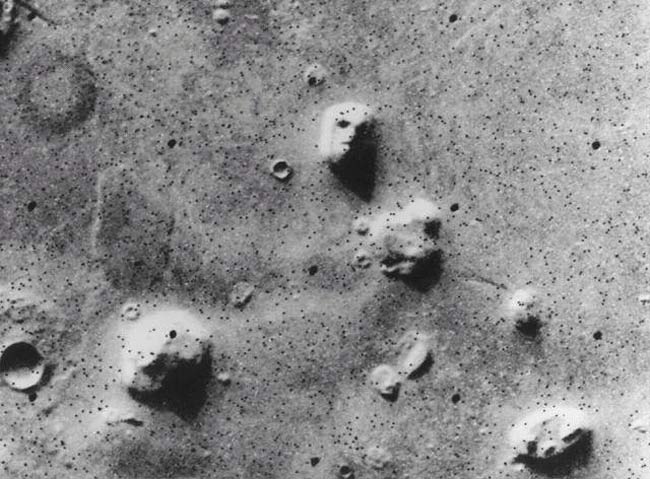
The Face on Mars
By now, you probably know where I’m going. With the popularization of AI, many metaphors have entered the IT language that:
- concern the mental and psychological sphere
- compare machine functionalities to similar features in humans.
This is nothing unique. The term on which the entire computer technology stands is, after all, “memory”. As early as the 1940s, its use was popularized by John von Neumann, who in his architecture formalized the division into a processor and a memory unit. He could have just as easily called it retention or a “bulbulator”. However, he chose - probably by analogy - memory, even though machine memory works differently than human memory.
It seems to me that today’s terms regarding artificial intelligence, which refer to mental traits in living organisms, were created on a similar basis. For example:
-
Neural networks - in reality, these are layers of mathematical weights, but at the conceptual level, we see them as interconnected neurons transmitting impulses with data
-
Learning, deep learning, training - we compare the optimization of complicated mathematical functions and tuning them to data to, for example, studying for a test
-
Hallucinations - we equate errors in predicting the next most probable words with serious cognitive function disorders
-
Crème de la crème, that is…
Intelligence
The metaphor of “intelligence” and its derivatives is probably the most powerful marketing ploy in the history of technology. It’s hard to believe that it has been used for a good half a century.
The term “Artificial Intelligence” was proposed by John McCarthy in 1956, during the famous Dartmouth workshop dedicated to “thinking machines”. It is possible that he chose AI because it sounded better than more adequate alternatives, such as Complex Information Processing. Along with the development of technology, it turned out that the choice was marketing-perfect, but at the level of the concept itself, very misleading.
In computer science, “intelligence” is defined very narrowly: as the system’s ability to correctly process data and use it to achieve specific goals defined in the program. In the context of AI, intelligence is mainly optimization. If an algorithm finds the shortest path in a maze or accurately predicts the next word in a sentence, we call it “intelligent”, even though it is a very specialized and purely mathematical ability.
However, the use of the word “intelligence” in the name of the new technology opened the gate wide to talking about it in the context of its alleged subjectivity and autonomy. We continue to rush eagerly into this absurdity, building further layers of associations and metaphors over it.
The matter is further complicated by the fact that “intelligence” in the colloquial sense of the word is an extremely blurry concept. It is not such an unambiguous feature as height, which can be easily measured and given in the appropriate unit.
In the context of people, “intelligence” can therefore mean various things, e.g. the ability to solve a difficult sudoku or an IQ test. It can also characterize someone who can recognize emotions (emotional intelligence) or uses irony efficiently. Some distinguish (8 and more varieties) of intelligence, further diluting the already weak meaning of this term.
In essence, however, “intelligence” most often refers to a Golem molded from individual ideas about what it actually means to be intelligent. It merges into one with such features as cleverness, wisdom, wit, sharpness, brilliance, being well-read and sophisticated, extensive knowledge. All inclusive, take what you want. Or whatever happens to suit you.
So we have quite a deep semantic swamp at the level of AI naming. We know it is intelligence, whatever that means in the context of machines. We also know it is artificial. If anyone were to question its values and suggest that it is something else than intelligence in humans, one can always counter such accusations by pointing to its “artificial” nature. It’s hard to argue with that.
Ghost in the machine
Anthropomorphization in the context of AI is not only what is related to the mental sphere itself. In the agentic version, metaphors draw from various fields, even those as unusual for IT terminology as mysticism. The best example of this are Souls, i.e. Soul-type files. Thomas Aquinas likes this.
Souls are files in Markdown format. They contain directives written in natural language that define the agent’s behavior. File sections can contain attributes such as:
- Core Truths - rules that guide the agent’s actions, e.g., “I do not mislead. If I don’t know something, I admit it”
- Boundaries - they set boundaries that the agent cannot cross, e.g., “I do not provide medical advice”
- Vibe - it’s actually a description of the agent’s “personality”, e.g., “Ironic but helpful expert”
- Example Interaction - conversation scenarios showing how the agent should behave in practice
- Communication Style - the way of formulating statements, e.g., “Short and to the point, without emojis”.
You see it, right? This mix of random terms taken from a corporate annual appraisal template and a philosophy textbook. And that’s not all. Depending on the implementation and your own imagination, you can add a whole range of other attributes to Soul.md such as: Goals, Anti-Goals, Decision Rules, Persona, Knowledge Scope, Tone Guardrails, Failure Mode, Context Awareness, Constraints. Google Agent Development Kit also relies on “personalities” and “personas” for its agents in its instructions.
Soul.md is an attempt to graft a substitute for personality onto a stochastic model. Nevertheless, thanks to it, we can achieve a relative sense of stability in prompting, because the model reads this file at the beginning of each conversation and consistently implements the guidelines contained therein. You can write such “souls” yourself, but you can also download them from soul repositories.
It’s also in “good vibe” to talk about “responsible” and “ethical” AI. I put the names in quotation marks because attributing moral traits to programs seems a bit immoral to me - after all, we are talking about the ethics of an advanced calculator. However, the creators of LLMs persist and tell us that some system of values follows this technology, a hilarious example of which is Claude’s Constitution. It somehow takes the responsibility off them for many not-so-glorious phenomena that go hand in hand with the development of artificial intelligence, such as stealing the entire internet or draining natural resources needed for the construction and operation of subsequent data centers.
In praise of folly
People can create an explanation of observed phenomena from a very small amount of information. For this purpose, they use generalizations, logic, collected knowledge and experience. AI, on the contrary. It is a huge mirror of data produced by humanity. Based on them, it creates potential explanations that do not have to be reflected in reality - if they have them, it is only on the basis of a well-executed throw in statistical roulette. In some areas, especially those that had a large written representation, AI does great. So great that it gives the illusion of a conversation with an exceptionally gifted, intelligent individual. In other areas, in turn, it lies and squeals. It makes basic mistakes, is wrong, babbles, wanders.
This fits perfectly into the so-called Moravec’s paradox. In the 1980s, Hans Moravec, Marvin Minsky and Rodney Brooks noticed that high-level mental operations (e.g. playing chess, proving mathematical theorems) require relatively little computing power. In turn, low-level sensory and motor skills (e.g. jumping, manipulating objects) – considered easy to master and appearing in humans at a very early stage of development – require huge resources. AI can therefore easily defeat a human in a game of chess, but the mobility of a one-year-old child is currently beyond its reach. People get such basic skills in a package with genes as a result of millions of years of evolution. We perform them reflexively, which makes them seem effortless. And they are not. We just have them already “embedded” in our hardware and we don’t have to recreate the entire process of learning them every now and then.
And yet it is this high-level intelligence that is treated by humans almost as a fetish and associated unequivocally positively. Its deficit comes down to the statement: you are stupid. And nobody wants to be considered a dimwit, right?
It seems to me that this is exactly why AI is such an excellent trick at the naming level. Dealing with artificial intelligence, we feel smarter and somehow more noble ourselves. We believe it because it gives the impression that it understands us perfectly. We are happy when we notice its mistakes, because it’s good for our self-esteem and faith in our own intelligence.
And here we come to a paradox. On the one hand, we personify AI as a boundless source of knowledge. On the other hand, we give it a unique benefit of the doubt that we wouldn’t give to any other popular technology. We allow it embarrassing hallucinations and eagerly forgive them. We even write them into the essence of AI, although allegedly “to err is human”. So again: we measure technology with our own measure and anthropomorphize.
The ups and downs of LLMs
But let’s end with the theory. In practice, LLMs are awesome.
Currently, I am an active user of several models in their freemium versions. I use them privately and at work even though there were cases that I received answers from them taken straight out of a digital ass. However, I can openly admit that I can no longer imagine life without AI. I write this with a certain nostalgia, because until recently my basic sources of knowledge were Wikipedia and StackOverflow. Currently, I visit these portals occasionally, because I get everything immediately in the model’s app or in a search engine with AI mode. It takes away a bit of the sense of agency and makes you lazy. Moreover, it made me start thinking in prompts in my searches on the web, and not in keywords, as it used to be.
To sum up: this fart cannot be let back into the ass. AI will stay with us not only because it is a breakthrough technology for the development of which giant money and resources were burned. It will stay with us because it really changes the world, differently and to a different extent for everyone. It affects how people function and in what conditions they live. Let us remember that data centers for LLMs are an energy-less pit. They consume giant amounts of electricity, and unspent resources of water are needed to cool them, which may soon become our greatest wealth, which we will not prompt in any way.
This aspect of the current march of AI through the world is truly terrifying. At the end, I return to Barbara Ehrenreich. Read her books. In addition to the already cited “Natural Causes”, I also recommend reaching for “Had I Known” and “Nickel and Dimed: On (Not) Getting By in America”. Both positions allow you to take your head out of your own bubble and look at the world that is collapsing along with Eldorado.