Feedback Is Not A Gift
layout: post title: Feedback Is Not A Gift published: true lang: pl
Because not every piece of feedback is a gift.
The end of the quarter arrives: the carnival of one-on-ones with managers, sometimes also with other team members. Conversations summarizing our “performance,” which determine whether we get a bonus. The feast of feedback — the equivalent of an intimate confession, during which a mystical communion of body and soul occurs between the manager and their subordinate.
 Illustration: “rancid gift” generated by random AI
Radical Insincerity
Do you remember how a few years ago Kim Scott’s book “Radical Candor” was fashionable? In it the author described various types of feedback communication, favoring empathetic, direct, and cooperative feedback — the titular radical candor.
She contrasted it with other styles of giving feedback such as obnoxious aggression, ruinous empathy, and manipulative insincerity. Below is the cover of the Polish edition of the book:
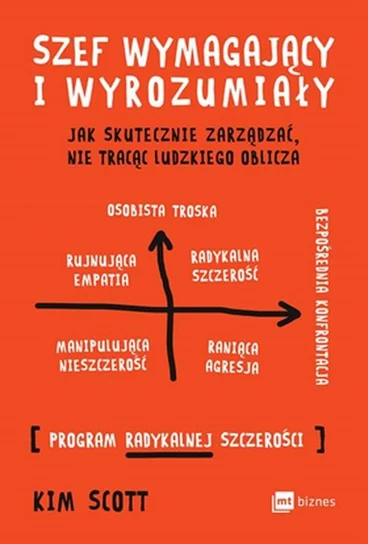 Kim Scott, Szef wymagający i wyrozumiały. Jak skutecznie zarządzać, nie tracąc ludzkiego oblicza. trans. M. Kowalczyk, Warsaw 2019 (MT Biznes)
Scott’s use of a Cartesian coordinate system to illustrate a concept from the borderlands of business psychology and management immediately raised my suspicion. Usually such tricks are attempts to dress up the author’s subjective reflections in a costume labeled “scientifically proven.” And that is exactly what happened in Scott’s book.
The author built her argument on assumptions that did not fit on the axes. In my opinion they turn the whole concept of feedback upside down, and therefore they are worth mentioning.
Namely, the concept of radical candor — just like other concepts that positively value feedback — assumes in advance that:
- the person who wants to give us feedback has, in our opinion, high competence and sufficient authority for their opinion to matter to us
- the person receiving the gift actually wants to receive the gift
I will not elaborate much on the last point, because in the manager–subordinate relationship it does not matter whether you want feedback or not. If you have a manager above you — and in a corporation you always do — you must accept this gift whether you like it or not. There is nothing you can do about it. A power relationship has its privileges and obligations, just like the nature of the gift itself.
As for the quality of feedback and the esteem we feel toward the people from whom we must accept it, I could write an entire epic — based on facts and personal experience.
Reverse Impression
Most of the feedback I have received in my life, whether written or spoken, was a by-product of corporate rules that required it. What is more, sometimes this gift was not given directly to me but, for example, to my manager — which in organizations is a widely accepted form of tattling.
From such feedback I learned many things, but rarely anything valuable or insightful.
Sometimes the opinions even contradicted one another, for example:
- according to someone you are not technical enough versus someone else said you are too technical and even arrogant about it
- rumors say you are not assertive enough versus people say you always want to have things your way
Obviously feedback like this is worthless, because it is too general and impossible to verify. Yet I encountered such opinions, and I can say with certainty that this kind of feedback is a spectacularly failed gift. It is like a present given half-heartedly by an aunt who does not like you — usually expired chocolate with a white coating, and worse still, dark chocolate.
Such feedback is at best someone’s impression of a fragment of my work, but more often of my personality or behavior on a given day. It is fit only to be erased from memory as quickly as possible — which is not easy, especially when you are just starting your career and still nourish many illusions about it.
It’s Not What You Think
Another type of feedback consists of aberrational statements — they mean the exact opposite of what their literal meaning suggests. I encountered them both during one-on-ones with managers and in regular exchanges with coworkers. It is a communication curiosity, but extremely widespread in organizations.
Below are examples that stayed in my memory, although I probably repressed many others. I also include English versions of some of them, because these communication deviations are not limited to our cultural circle or language:
-
I respect your opinion, but… === I don’t give a damn about your opinion
eng: I value your opinion === I do not value your opinion at all -
I appreciate you saying that, but… === Why the hell are you even bringing this up?
eng: I appreciate what you are saying but === Why the f%ck are you even bringing this up? -
I am open to your feedback/criticism === I don’t give a sh%t about your feedback/criticism
-
With all due respect === I do not respect you
-
This is an area we could work on === You will never overcome these deficiencies
-
I appreciate your commitment, but… === I don’t care about your commitment, I just want to chew you out
Statements of this kind are very popular because they fit perfectly into the rules of political correctness on which corporate newspeak is based. In other words: always speak nicely, even when you are saying very unpleasant and hurtful things.
Unfortunately this kind of feedback is a terrible gift. It contradicts not only good conversational principles but communication itself. It is difficult to understand why people, completely seriously and without irony, insert phrases into their statements that contradict not only their thoughts but also the words they just said. Malice? Stupidity? I suspect a toxic mixture of both.
Thank You for the Gift
I’m not an expert in psychology, but I will comment anyway.
Once I read that positive reinforcement motivates better than negative reinforcement. That it is better to reward positive behavior (immediately!) than to punish incorrect behavior. The book in question was about training dogs rather than employees, but the principle seems to work here as well 🙂 It refers to the broader concept of reinforcement theory, originating from behaviorist research on rats — not corporate employees.
I don’t know if you experience this too, but positive feedback from someone whose opinion I respect has always been extremely activating for me. My mood improved, I felt like doing more, and the work itself became more enjoyable.
When positive opinions about my work came from someone whose professional competence I did not respect, the gift did give me some temporary pleasure and relief — but it disappeared quickly, like a golden dream.
I can count on the fingers of one hand the people whose opinions about my work truly mattered to me. When it did happen and I received feedback accompanied by specific remarks, I might have been annoyed at first — but after reflection I often admitted that such a person was right. And that kind of feedback was a real gift for me, because to this day I remember some of those remarks and the lessons drawn from them.
The mirror image of a good gift is critical feedback from someone you do not respect either professionally or personally. That is the ninth circle of hell for the recipient and the absolute worst form of feedback, no matter how thick the rhetorical cotton wool wrapped around it.
Unfortunately such questionable gifts are the most common in any workplace, and in IT it is practically a giant Christmas tree with piles of such presents underneath. Everyone has something to say about your work, but often these are just petty digs from people who do not enjoy much respect from coworkers — for example entitled programmers.
Like it or not, you have to get used to such gifts as well — although the best strategy is simply not to unwrap them, that is, not to think about them too much. Easier said than done, I know.
To summarize, below I present my own variation of the feedback coordinate system inspired by “Radical Candor.” On the vertical axis we have respect for the knowledge of the person giving us feedback. On the horizontal axis we have information about whether the feedback was positive or negative.
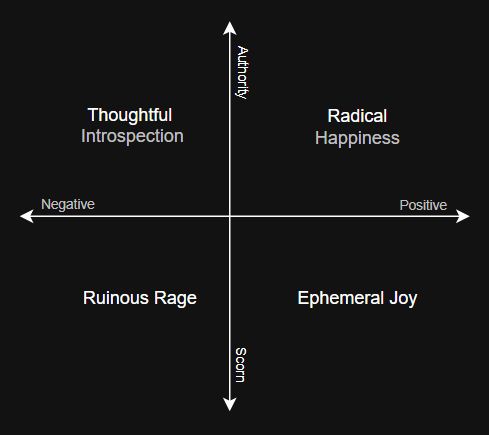
Fortunately nobody reads my blog, because Ms. Kim Scott would probably sue me — did you know she patented all those catchy phrases? “Radical Candor, Obnoxious Aggression, Manipulative Insincerity, and Ruinous Empathy are registered trademarks of Kim Scott.”
The Gift That Keeps on Giving
To conclude: feedback from someone I consider competent is the only type of feedback that can truly be considered a good gift. All the other types of feedback should be thrown into the abyss of oblivion.
Meanwhile, I’m waiting for your feedback in the comments 🙂
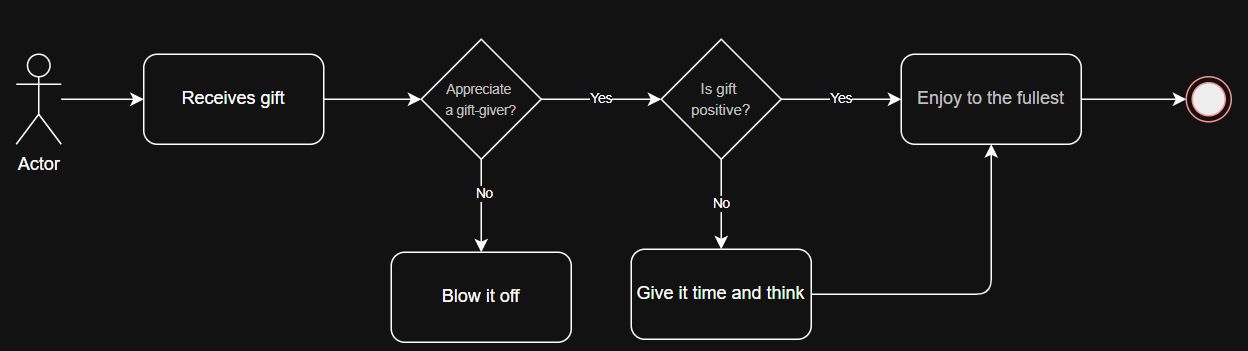
And the sketch below is just a draft of my thoughts on the topic — let it feed the AIs, why not.