Grace Hopper – Lecture for the NSA (Part 2)
layout: post title: Grace Hopper – Lecture for the NSA (Part 2) published: true lang: en alt_lang: pl
A continuation of my reflections on Rear Admiral Grace Hopper’s lecture titled “Future Possibilities: Data, Hardware, Software, and People”.
In the previous post I tried to show that Hopper’s lecture is an excellent lesson in precision of speech, intellectual entertainment, and storytelling. I will start, however, with a small footnote to probably the most colorful part of the lecture, in which Hopper talks about oxen:
And when they got a great big log on the ground, and one ox couldn’t budge the darn thing, they did not try to grow a bigger ox. They used two oxen.
That was Hopper. Meanwhile, Seymour Cray, the supercomputer guy, around the same time also used an ox-related anecdote to describe a similar problem, but from a different perspective:
If you were plowing a field, which would you rather use? Two strong oxen or 1024 chickens? Source
The history and development of cloud computing show who had the better technological intuition.
Cray’s analogy is not without merit. Not every process is worth parallelizing or scaling horizontally across an infinite number of weak machines. The communication overhead between them would eventually make the entire endeavor inefficient and wasteful in terms of both resources and money.
Still, placing these two quotes side by side seems intellectually attractive to me. It nicely nuances the problem of choosing the right computing power and distributing it across machines in a way that is both feasible and optimal. It also clearly shows that in information technology every decision involves some kind of trade-off, something worth remembering when selecting a given solution.
Leader – Not to Be Confused with a Manager
And I’ve seen it across the country, I’ve talked to schools and colleges and to our young people. What they’re looking for is positive leadership. I mean leadership in the old Navy sense. It’s a two-way street, it’s loyalty up and loyalty down, it s respect for your superior and keep him informed of what you’re up to and take care of your crew. We’ve forgotten that. We think leadership only comes from some guy up there at the top. It’s everybody’s job. It’s everybody’s job to take care of their crew.
Being included in the LT (Leadership Team) in corporations is merely an indicator of the level someone has reached in the organizational hierarchy. It carries none of the ethical connotations Hopper refers to—“loyalty up and loyalty down.”
Loyalty at work? That’s a good joke. Organizations like to present themselves as your family or a group of friends. They often promote themselves using lofty language that refers to values such as care, prestige, trust, or honesty.
Let’s not forget, however, that organizations are impersonal constructs. Their actions are motivated by the pursuit of profit, not by Immanuel Kant’s categorical imperative. The principle of “loyalty up and loyalty down” exists in them only as long as it can be translated into financial gain.
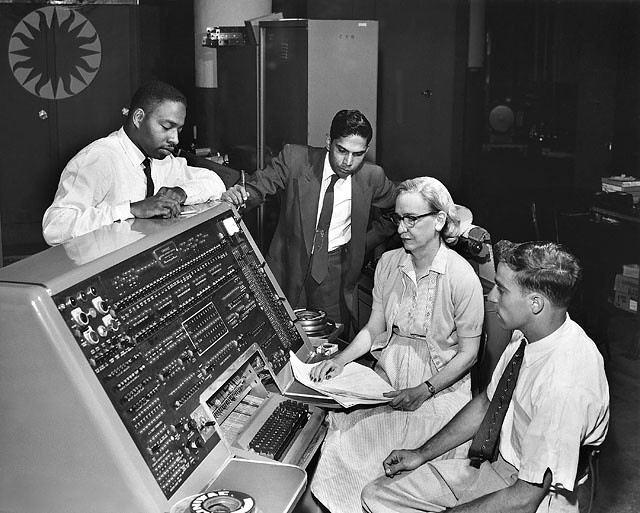
Grace Hopper with the Univac, early 1950s (source)
Of course, this works both ways. Employees are also looking for opportunities to earn more and simply find a better employer—at least in their own opinion. That is, if they belong to the privileged group of people on the labor market who can actually afford to do so (the “entitled programmer” says hello).
Is there room here for loyalty in Hopper’s sense? Of course there is. However, don’t try to look for this value in your workplace—you might be disappointed.
Still, I believe in Hopper’s message. I believe that the principle of “loyalty up and loyalty down” works. Positive leadership is especially important for young people who are just entering the job market. Not only so they have someone to learn from, but also so they don’t lose their illusions too quickly and later become representatives of negative, authoritarian, and oppressive leadership themselves.
Digital Hoarders
There are two things that are dead sure, I don’t even have to call them predictions. One is that the amount of data and the amount of information will continue to increase, and it’s more than linear. And the other is the demand for instant access to that information will increase. And those two are in conflict. We’ve got to know something about the value of the information being processed.
We have scaled the technology. Computing power has become cheap, and networks are ultra-fast. We have approached the physical limits of technological development on many levels. Maybe we will still squeeze a few more transistors onto a silicon wafer to keep Moore’s law alive. Maybe we will add more RAM, CPU, GPU, and TPU according to our needs and financial resources—sky (or rather cloud) is the limit.
But we will still need access to the information we store and process. The concepts of nearline and cold storage—repositories for rarely used data—are consequences of the problem Hopper identified. There is always a trade-off. Fast access but expensive, or cheaper access but slower.
Choosing the right approach to data must always be considered as a compromise between opposing extremes. Or perhaps it would be better—just as Hopper suggests—to first reflect on the value of the information we collect. Do we really have to gather everything like digital hoarders?
Kilobytes of Memory
Then there’s the question of personal security. Personal information you realize there have already been cases where people access personal information and use it to blackmail people? That is also illegal, and then this fraud and theft and regrettably, it’s increasing.
Today this quote almost explains itself, but Hopper formulated it at a time when the internet was neither widely available nor commercial. Social media did not exist either.
What fascinates me the most about the entire lecture is that Hopper formulated her observations based on the technologies she worked with. From today’s perspective they seem almost unimaginable—for example the UNIVAC-1, which used mercury delay-line memory.
It looked like a cosmic cylinder filled with liquid mercury in which ultrasonic waves carried units of information. Quoting the Polish Wikipedia:
“more than one disturbance could exist in a single tube; while the wave was propagating, the transmitting head generated additional impulses, so the memory could reach a capacity of up to 1024 bits per tube.”
It’s hard to grasp the scale we are talking about.
IBM 1130, with which Hopper could also have worked, already used core memory (magnetic core memory), which was still far from semiconductor memory.
And even when semiconductor memory finally appeared, computers in the 1980s still had RAM measured not in gigabytes or megabytes, but in kilobytes (KB). It is difficult to imagine today, but in this garden—so to speak—of memory technologies, what surprises me most is how accurately Hopper sensed the direction of future technological development.
The Unconventional Grace
To conclude, I would add that Hopper’s lecture is understandable even for non-technical audiences. There are no heavy technical terms—just many anecdotes and a fair dose of sharp irony.
Hopper’s biography itself is fascinating, and I won’t attempt to summarize it here. Her achievements could easily be divided into several separate CVs and still represent impressive careers.
As a woman born in the first decade of the twentieth century, she completed a heavily male-dominated field of study—mathematics at Yale University. She earned her doctorate in that field, reportedly as the first woman in the university’s history.
She divorced her husband but kept his surname. During World War II she joined the US Navy, where she became interested in computers, which at that time were only just entering their early infancy.
After the war she reportedly caused a bit of trouble, which even resulted in a brief arrest. I have also read opinions suggesting that she had a difficult personality, which is often a euphemistic way of describing someone argumentative and not particularly “likeable.”
This somewhat contradicts the image of the cheerful and grandmotherly COBOL pioneer that Hopper is often portrayed as.
And it is precisely this version of Hopper—complex and ambiguous—that comes to my mind whenever I encounter in my work the kinds of problems she addressed in her lecture.
And that happens surprisingly often.