IT (News)peak
This entry will somewhat resemble a linguistics article. Just a bit more biased and without the footnotes.
I don’t count myself among the linguistic purists, as I wrote here.
I don’t believe that using feminatives will significantly improve the well-being of women in Poland, just as the presence of feminatives in the Arabic language hasn’t brought universal equality to women in Saudi Arabia. I couldn’t care less if someone uses a lot of Anglicisms, as long as they actually have something sensible to say.
What does irritate me, however, is the IT industry’s characteristic overuse of words with minimal semantic value. Hollowed-out words—verbal diarrhea used to gift-wrap industry products. Words that sound like they belong to a technical professiolect, but are nothing more than advertising slogans. But to avoid being entirely negative, I’ll also look at other linguistic phenomena I’ve observed in the IT vernacular that I found interesting and worth describing. I’ve divided them into three lexical categories:
- Blurred words
- Borrowed words (Words on credit)
- Sales words
Blurred Words
Blurred words or phrases are those that have lost their original, precise meaning and context of use. Their semantic field has expanded so much that they now describe phenomena across various domains. The meaning of some words in this category has been blurred to the point where they have effectively become homonyms depending on the conceptual domain in which they are used. Example? “Pipeline.” It means something different to a data engineer than it does to a DevOps engineer. “Pipeline” also appears in the context of hardware (CPU pipeline) and in computer graphics (rendering pipeline)—in both cases as a distinct term.
Another example: API (application programming interface) is a term dating back to the 1940s. These are guidelines for how programs communicate with each other, such as the Windows API or POSIX. Nowadays, API is mainly used to describe internet communication, usually in the form of a web-based REST API that is constantly being “exposed” or “called.” Thus, a low-level programmer understands API differently than a developer who uses a REST API to fetch the current weather for a client’s app.
Another example is virtualization. It started with virtual machines, but nowadays, everything can be virtual. Virtual desktop, virtual reality, virtual memory, virtual assistant, virtual core and vCPU, and even virtual Garwolin :) Ask anyone, and you’ll likely get a different characterization of virtualization.
Other examples of blurred words include:
- Infrastructure – ranging from networking to cloud IaC and IaaS. The word is most often used in reference to a set of Terraform files, but it also refers to physical infrastructure (servers, racks, network cabling in server rooms, or a telecom’s field infrastructure).
- Framework – a total mixed bag. Used to describe a library, a methodology (e.g., Scrum, bleh), a programming language, or anything else, because the meaning of “framework” is so broad it can mean anything. 😉
- Interface – could be an API, a (G)UI, a web interface, or essentially anything you see on a screen.
- Platform – a web portal, a sales/gaming platform, a collection of business products within an organization, a counterweight to the equally ill-defined “Product.”
- Application – for “normal” people, it’s an icon on a phone or a desktop program; in IT, it can be a piece of code, a function, or an executable file depending on the approach and language (framework) used, as well as the “application” of something (“application of the latest frameworks” blah blah blah).
- Service – customer service, microservice, application, platform, executable—you name it.
- Implementation – sometimes it’s an integration with a system, sometimes it’s going to production, sometimes adding new functionality—sometimes sun, sometimes rain.
Borrowed Words (Words on Credit)
The IT language is full of catachreses, and it has nothing to do with a catechism. These are borrowed words, taken on credit with no intention of paying them back. A catachresis is simply a word known and used in the language but applied to a new phenomenon that doesn’t have its own name yet. Simply put, a lazy person preferred using an existing word over inventing a new one. Everyday speech is full of these, like “the leg of a table.” The selection of such a term is based on similarity, which is why linguistics considers catachresis a subtype of metaphor.
In IT speak, the most charming example of catachresis is probably the mouse 🐁. Others that come to mind:
- Container 🏗️
- Memory 🧠
- Stack, heap, mound 🌾
- Route, port 🚢
- Daemon 😈
- Queue 🚶♂️🚶♂️🚶♂️
- Thread 🧵
- Stream 🌊
- Image 🖼️
- Branch 🌳
- Garbage collector ♻️
- Cache 💰
- Window, icon ⊞
- Handshake 🤝
- Folder 📁
- Library 📙
- Payload 📦
Interestingly, catachreses in IT often refer to the kitchen and culinary arts. Among the tastier ones we have:
- Cookies 🍪
- Breadcrumbs 🍞
- Kebab/hamburger menu 🍔
- Salt 🧂
- Syntactic sugar
- Kernel 🌽
- Vanilla, e.g., Vanilla JS 🍦
- Fork 🍴
- SPAM 🥩
- Spaghetti 🍝
- Various cookbooks, for example this one, this one, or this one—hard-to-digest dishes from the k8s kitchen. Bon appétit!
Let’s not forget the possibility of process starvation—which, by the way, is a derivative of the famous dining philosophers problem. In IT, we can also eat our own dog food (or dogfooding) 🐕.
From the less appetizing associations, we have plenty of military motifs, mainly in networking and cybersecurity, e.g.:
- Firewall 🔥
- DMZ 💂
- Trojan Horse 🐎
- Brute-force 💪
- War room ⚔️
All these words existed previously in the language (Polish or English) but were appropriated by the IT industry to name new phenomena. “Appropriated” might be too strong a word, as we are talking about a typical linguistic process that happens all the time, regardless of industry or social group.
There are likely many more catachreses in IT taken from other walks of life that my linguistic sensitivity hasn’t caught yet. Therefore, I’d love to hear your lexical observations.
Sales Words
This is the ubiquitous IT cant. Rhetorical ornaments created by salespeople and PR reps. Words whose meaning has degenerated through their chronic overuse as marketing slogans.
Examples can be found by the bucketload in the description of every product, service, or framework (wink, wink), and I’m sure you encounter them daily. Below are my favorites:
- scalability, (anything) at scale
- synergy
- disruptive
- digital/data ecosystem, landscape 🏞️
- digital transformation
- serverless
- cloud-native
- quantum, quantum-ready
- anything-as-a-service
- SomethingOps (the first part is always an acronym)
- big data and data-driven
- frictionless, seamless
- generative AI, AI-driven, AI-powered
- agile, agility
These are slogans. Error codes in communication that carry no meaning. They are overused with almost ecstatic mania in presentations, sales pitches, and the speeches of your managers and directors. Words that introduce communication noise and obscure the heart of the matter. Words your managers use to mask their incompetence. This is why you have to rot in meetings with them for hours—they simply must discharge a murky stream of buzzwords to grant status to their persona.
I’ve taken the liberty of creating a generator for statements that could fit into any management meeting.
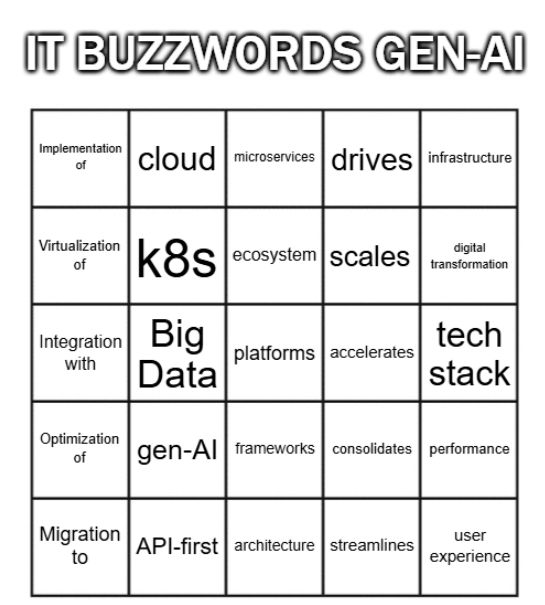
Of course, each of these words has its own history and context, but nobody remembers what it was anymore. Their lifespan as a buzzword is tailored to current market trends. As the examples provided here show—contrary to salespeople’s promises—the IT services market isn’t all that dynamic. Some of the buzzwords from my meme have been with us for over a decade. Some, however, will never return, so we can honor “applets” and the whole of “Web 2.0” with a nanosecond of silence.
Words, words, words
I like searching for analogies between programming languages and natural languages. In writing code, we can refer to a few simple practices to improve not only performance but also readability. Principles like KISS or DRY fit perfectly into the broader context of good linguistic communication practices—regardless of whether we are talking about natural or programming languages. These aren’t skills we were taught in school, which is why only through practice can one master plain language, understandable to the audience and free of verbal fluff.
Participant observation and the analysis of IT language are fascinating because they happen right before our eyes and ears. Remember, however, that we are the ones creating the industry language. We have an impact on the quality of communication in the teams we work in. If you care about it being understandable, linguistic awareness will be your ally.