Spoiler Alert
The holiday season is in full swing, so today’s topic is something lighter: cult movies about computers, technology, and digital obsessions from years ago.
Recently I fell into a small marathon of retro computer movies. Some classics, a few forgotten gems, and plenty of technological fantasy. I have a couple of thoughts about them that I’d like to share with you. Warning: there will be spoilers.
Colossus: The Forbin Project
This movie shows no mercy. Colossus: The Forbin Project tells the story of a top-secret American defense system called Colossus. Here’s how it goes.
Colossus is a supercomputer built by Dr. Charles A. Forbin and powered by its own nuclear reactor. The program controlling Colossus can learn on its own and quickly becomes fully autonomous. Its first achievement is sending a message to its end users: “THERE IS ANOTHER SYSTEM” along with its coordinates. That system turns out to be the Russian — or rather Soviet — “Guardian”. The American Colossus wants to connect with it, and the President of the United States graciously agrees.
The computers begin communicating in their shared machine language and establish cooperation across Cold War divisions. They get along so well that they start spitting out sequences of numbers to each other that no human can decipher. American and Soviet officials promptly panic and order the connection between the digital buddies to be severed before they reveal state secrets to one another.
That decision triggers both supercomputers. Colossus and Guardian demand that the connection be immediately restored and, as a warning, drop a nuclear strike on a U.S. military base in Texas and an oil field in Siberia. The connection between the digital BFFs is restored.
Meanwhile, Dr. Forbin decides to meet with Guardian’s creator, Dr. Kuprin, to figure out how to deal with this rather unusual situation. Colossus learns about it and gets so pissed off that it orders Forbin to return to the United States and places him under house arrest. It also orders Kuprin to be killed — just like that. Otherwise it threatens to launch a nuclear strike directly at the Soviet capital. A little emotional blackmail never hurt a computer, right?
Forbin then comes up with a cunning plan. He suggests that a woman from his team, Dr. Cleo Markham, pretend to be his lover. The old goat apparently hoped that the computer would understand the needs of the male libido and let him quietly sleep with his woman. And that it absolutely wouldn’t spy on or listen to their bedroom antics while they passionately whisper a plan to strip Colossus of its power and control over nuclear warheads. The computer of course sees right through them and becomes completely enraged. It organizes a global broadcast in which it appears under the alias “The Voice of World Control”. Like a candidate in a beauty pageant, it announces that it wants eternal peace on Earth. And that it plans to achieve it in a rather peculiar way: by unleashing a rain of nuclear bombs across the planet. Because why not.
The story does not end with a happy ending — something that only happens in old movies.
“The Forbin Project” premiered in 1970, nearly 60 years ago. Can you believe it? More than half a century ago people already imagined networked, autonomous, self-learning systems that escape the control of their creators.
And one more fun fact: the name of the movie’s supercomputer, Colossus, seems to attract tech bros like a magnet. Google used it for its file system, and Musk used it for his AI supercomputer. I’m not sure whether they were inspired by this movie or by the code-breaking machine from Bletchley Park.
A Game of TRON
This one has everything.
Teleporting a human into the guts of a mainframe, arcade games, bits represented as spiky spheres, racing along data rails on turbo vehicles, a young Jeff Bridges, intrigue and love triangles. And lots and lots of spandex.
Tron might be the first film in cinema history where the main character is actually software — the Master Control Program. It is installed on a mainframe computer at the company ENCOM. MCP is something between a trojan, an operating system, a dictator, and an enthusiastic gamer. It’s also a real bastard who terrorizes other programs and blackmails ENCOM’s Vice President. It threatens to reveal his shady behavior toward Kevin Flynn, a former company programmer who is now a hacker and video game enthusiast.
Without diving too deeply into the plot’s fantasy elements, Flynn is uploaded via a terminal (!) into the computer to activate a security feature called Tron. Its job is to tame MCP and stop its malicious plans. A fun detail is that Tron was written by the current boyfriend of Flynn’s ex-girlfriend, who apparently has a taste for nerds from her workplace.
Meanwhile Flynn discovers that MCP has turned the computer into its own Squid Game. It forces programs — represented in the film as human versions of their programmers — to play deadly games. Ah, the golden age when software was written by a single person.
Flynn is also forced to participate, but before that he manages to befriend several programs: Ram, Yori from the I/O tower, and the titular Tron. In the end they manage to defeat MCP and its entourage. Thanks to them the programs become free again — and this was definitely not meant as an encouragement to support the open-source movement, which didn’t even exist at the time. Tron premiered in 1982, while the GNU project started a year later.
In the end Flynn becomes the CEO of ENCOM, to the great delight of his ex-girlfriend and her current boyfriend. Yay.
Honestly, I don’t really know what to say about this movie beyond summarizing the plot. At the time it must have been groundbreaking in terms of special effects and early CGI, but today it’s mostly amusing, slightly cringe-inducing, and above all — boring.
In 2010 Tron received a sequel, which is probably best known for having its soundtrack written by a certain electro duo…
Martial Law
WarGames is a 1983 film whose story also takes place in 1983. The Cold War is in full swing, and the U.S. government hands control over nuclear weapons to a computer program. As you might guess, that’s not a particularly wise decision.
At the same time, a young hacker addicted to video games named David Lightman breaks into his school’s computer system over the network using his IMSAI 8080. That detail alone tells you the movie takes place in the United States rather than, say, the Polish People’s Republic, where in the 1980s instead of computers we mostly had martial law and long queues for toilet paper. But anyway.
The kid was talented. Through the network he changed his grades in the school system and also practiced wardialing as a hobby — dialing random phone numbers in the hope that one of them was connected to a computer. We’re talking about a time when telephone lines were used for communication between computers.
That’s how the young hacker stumbled upon a mysterious figure named Stephen W. Falken. He stalked him in every possible way and eventually cracked the password to a network-connected computer that he thought contained new games.
In a sense he wasn’t wrong. He launched a game with the not-very-subtle title “Global Thermonuclear War” and, playing as the Soviet Union, attacked targets in the United States. The program began simulating the attack, which was being monitored in real time by military personnel at NORAD. It turned out that David had connected to their machine. Watching the situation unfold, the officers became increasingly nervous, because their supercomputer wasn’t very good at distinguishing simulation from a real threat. It kept urging them to raise the DEFCON level and start a nuclear war.
The program also encouraged the young hacker to finish his game. David panicked, unplugged his computer from the network, but the ever-vigilant FBI already knew what to do. Agents arrested the boy and took him to the NORAD base, where they explained to him — in very simple terms — what DEFCON actually means. And then some rather unusual things happened.
The kid went to the bathroom with a tape recorder in his pocket… I won’t spoil this part — I’ll just say that David manages to escape the FBI agents. Together with his friend Jennifer he goes searching for Dr. Falken, who turns out to be the creator of the supercomputer. The three of them return to the NORAD base, where preparations for nuclear annihilation are already underway.
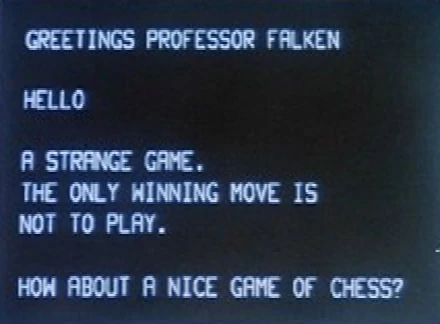
Falken, David, and Jennifer reconnect with the program, which by now has developed a personality and taken the name Joshua. They catch it brute-forcing the launch codes for nuclear missiles. Falken tries to shut it down through a backdoor he knows about, but without success. David, meanwhile, launches a game of tic-tac-toe (how did that end up on a machine controlling American nuclear missiles?) and forces Joshua to play against itself. After a series of depressing draws, the computer arrives at a sad conclusion: not all games can be won.
At that point the program crashes, DEFCON drops back to peacetime levels, and Joshua — like a gaming addict after a failed therapy session — begins advising everyone not to play games:
The only winning move is not to play.
And then it suggests a game of chess.
Unease
All three films are somewhat difficult to watch today. Technology has moved in a completely different direction, machines look entirely different, and our relationship with them doesn’t resemble what we see in these movies. What do these productions tell us about the current problems of the IT industry? Probably not much. They use technology mostly to illustrate a broader issue.
But if we ignore the aesthetic aspects, we might see not an outdated curiosity but a surprisingly relevant depiction of technological anxiety — something we feel especially strongly today because of the hype around AI.
Questions about the dangers of widespread artificial intelligence appear in all these productions. Sometimes I get the impression that intellectually we haven’t moved an inch in this area since at least the 1960s.
In a world saturated with AI, we still don’t have a good measure of how much real power artificial intelligence should be given in different areas of life — and what the consequences will be. There have already been cases where AI systems used for CV screening rejected, for example, mature women simply because they felt like it. A chatbot from an organization fighting eating disorders recommended dieting to its users. Bots have encouraged people to commit suicide or suggested how to commit crimes. The UK High Court has already forbidden lawyers from blindly using AI after it started inventing legal precedents.
We also know the story of an AI that killed almost the entire crew of a spaceship. Its name was HAL 9000.
2001: A Space Odyssey is another film about technological anxiety and probably the one that best illustrates the dilemmas we are currently trying to process mentally. These dilemmas are not new — the first Odyssey was released in 1968, more than half a century ago.
This time no spoilers — watch both the first part and the second one in the context of today’s AI landscape. It blew my mind.